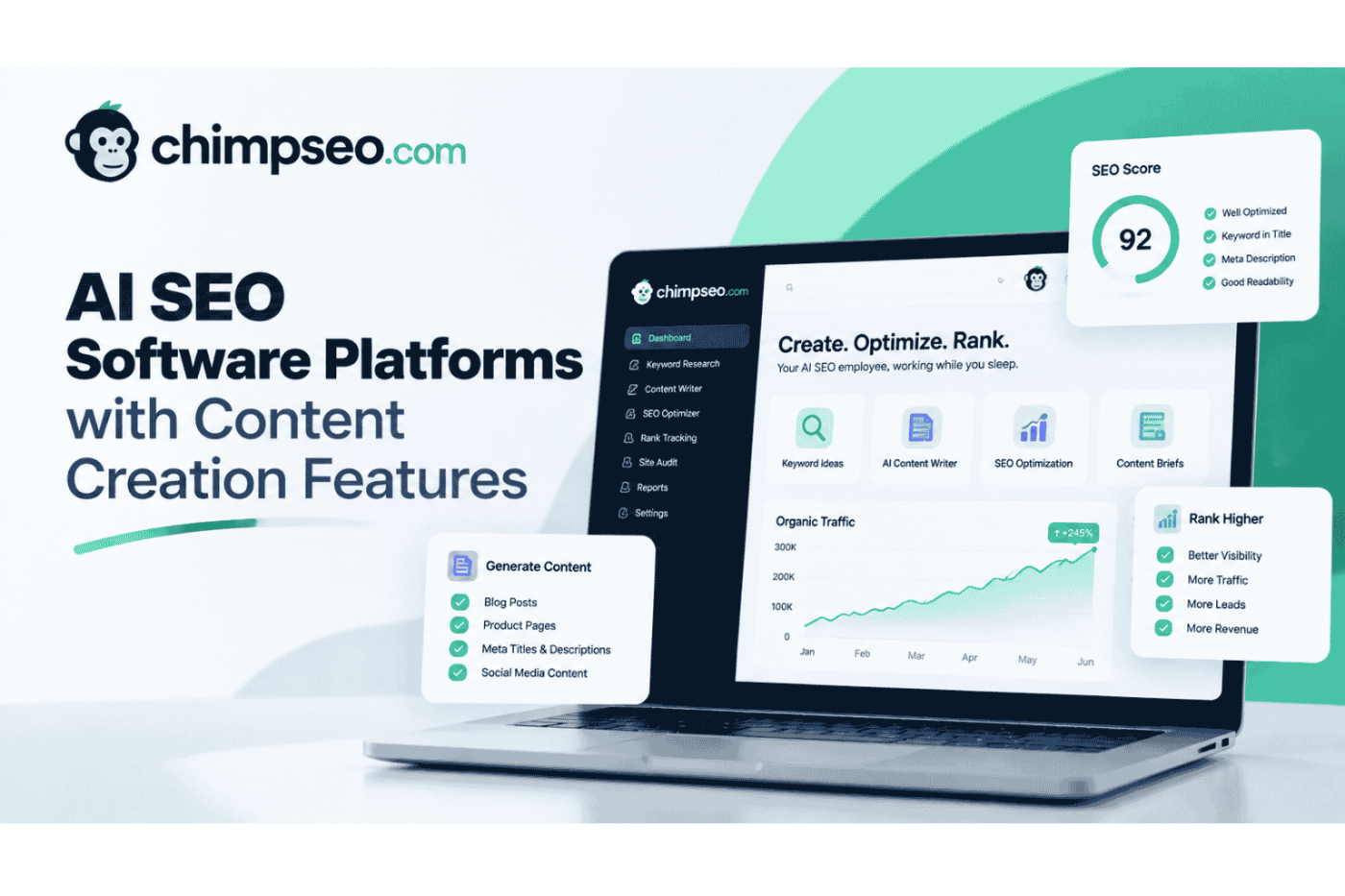
The traditional search engine optimization stack is undergoing a fundamental structural shift. For years, digital growth teams relied on a piecemeal tech stack: one tool for keyword discovery, a separate software for SERP competitor analysis, a standalone AI writer for drafting, and manual editing spreadsheets to tie everything together. This fragmented approach not only decelerates publishing cadence but also creates dangerous context drops between search intent analysis and execution.
Today, next-generation ai seo software platforms with content creation features eliminate those bottlenecks. By combining search intelligence directly with generative AI text engines, these unified systems convert keyword research into fully optimized, search-ready articles in seconds rather than days. In this comprehensive guide, we examine how modern AI-powered search engines operate, the core capabilities required to achieve top rankings, and how to deploy automated workflows to scale your organic performance.
1. The Evolution of AI SEO Software Platforms with Content Creation Features
To understand why unified AI SEO systems are winning market share, one must look at how Google and Bing evaluate web content. Modern search engine algorithms rely heavily on Natural Language Processing (NLP) models, such as Google's Gemini and BERT architectures, alongside semantic vector search. These algorithms do not merely look for exact-match keyword density; they evaluate page intent, topical coverage depth, entity relationships, and Experience, Expertise, Authoritativeness, and Trustworthiness (E-E-A-T).
When content creation is disconnected from real-time SEO intelligence, writers frequently miss critical LSI (Latent Semantic Indexing) terms, sub-intent variations, and structural patterns that search engines demand for top placement. An integrated platform solves this by running a live SERP audit before a single paragraph is written.
Key technological shifts in modern AI SEO software include:
- Real-time SERP Scraping: Fetching page-one competitors dynamically to extract actual semantic entities and outline structures rather than relying on stale cached data.
- Intent-Aware Neural Generation: Contextualizing draft generation based on intent classification (informational, commercial, transactional, navigational).
- Topical Authority Mapping: Automatically grouping keywords into structured content clusters that prove deep domain expertise to search crawlers.
- Automated On-Page Optimization: Structuring heading tags (H1, H2, H3), meta tags, image alt texts, and readability indices directly inside the content generation editor.
2. Core Capabilities Required in Next-Gen SEO Software
Not all AI writing tools qualify as complete SEO software platforms. Many generic generative AI wrappers simply prompt a base language model without evaluating current search rankings. To achieve consistent Google search visibility, your platform must offer advanced, search-focused architecture.
When evaluating modern platforms, ensure the software includes the following essential core features:
A. Live SERP & Semantic Entity Extraction
An effective platform analyzes top-ranking URLs for your target search term, mapping out missing semantic entities, recommended word count targets, paragraph depth, and question patterns (e.g., Google People Also Ask data). This guarantees that generated drafts match search engine expectations immediately.
B. Automated Keyword & Gap Discovery
Rather than making you export endless CSV files, top-tier platforms continuously scan your domain alongside main competitors, highlighting low-competition, high-volume keyword opportunities that can be dispatched straight to the generation engine.
C. Integrated AI Writing Engine
Having natively built creation tools like an AI Article Writer eliminates copy-pasting data across browser tabs. The software writes coherent, engaging content styled to your brand voice while maintaining proper formatting, precise heading hierarchies, and natural keyword density.
D. Structural Internal & External Linking Logic
Internal links remain one of Google's strongest rank distribution signals. Modern tools parse your published site map to insert contextually accurate internal links automatically during the content generation process.
3. Scaling Organic Traffic: Programmatic vs. Niche Strategy Execution
Scaling content requires matching your SEO strategy to your business model. AI SEO software platforms excel at two distinct growth models: scalable programmatic deployment and deep niche publishing.
Executing Programmatic SEO
If your business model targets thousands of long-tail search queries (e.g., location-based landing pages, directory structures, e-commerce product comparisons, or templated SaaS workflows), human creation becomes cost-prohibitive. Leveraging Programmatic SEO allows engineering and marketing teams to scale page creation systematically. The software pulls structure from datasets and uses generative AI engines to write dynamic, non-repetitive content across massive page clusters without triggering duplicate content penalties.
Dominating Hyper-Focused Niches
Conversely, strategies tailored For Niche Bloggers and specialized affiliate creators demand exceptional topical depth. Instead of publishing thousands of broad pages, niche publishers must systematically eliminate keyword gaps in specific verticals. The AI software assists by mapping out holistic topic clusters, generating pillar content, and producing targeted cluster posts that signal unquestioned domain authority to search crawlers.
💡 Pro Tip: When evaluating AI SEO platforms, always test their ability to inject live search intent into drafts. Static AI language models miss real-time entity shifts; top-tier systems scrape page-one competitors live before generating outline frameworks.
4. Comparing Workflows: Manual SEO vs. ChimpSEO Autonomous AI
To quantify the efficiency gains of adopting an integrated AI SEO platform, consider the standard operational metric comparisons between traditional human-driven workflows and ChimpSEO's automated publishing engine:
| Feature / Metric | Manual SEO Workflow | ChimpSEO Autonomous AI |
|---|---|---|
| Keyword & SERP Research | 2 to 4 hours per target term | Automated in under 30 seconds |
| Content Drafting Time | 4 to 8 hours per article | 60 seconds (1,500+ word draft) |
| Semantic Entity Coverage | Manual auditing using external checkers | Native real-time competitor NLP extraction |
| Internal Link Insertion | Manual cross-referencing | Automatic Contextual Linking Engine |
| Average Cost Per Published Post | $150 – $400 (Agency/Freelancer) | < $2.00 (Inclusive of platform cost) |
| Publishing Scalability | 5 to 15 posts per month per writer | Hundreds of search-optimized posts monthly |
5. Step-by-Step Blueprint to Launching AI-Optimized Articles
Transitioning to an AI SEO workflow does not mean sacrificing quality or audience trust. Follow this proven 5-step operational framework to publish high-ranking, engaging content efficiently:
- Identify High-Intent Keyword Gaps: Input your seed niche or primary domain into ChimpSEO. Filter targets by search intent and keyword difficulty (KD) to target actionable opportunities.
- Run Autonomous Competitor SERP Analysis: Allow the AI engine to crawl top-ranking search pages, pulling necessary entity frequencies, structural headings, and contextual questions.
- Configure Content Generation Settings: Set your target audience, tone of voice, required visual style, and target word count. Review transparent pricing tiers via our transparent Pricing Plans to choose the generation volume that fits your goals.
- Generate and Refine the Draft: Trigger the generation pipeline. In seconds, review the draft for unique proprietary insights, expert quotes, or custom brand references.
- Publish and Index Fast: Push the final HTML directly to your CMS (WordPress, Webflow, or Shopify) and submit your updated URL structure to Google Search Console for rapid indexation.
Frequently Asked Questions
Does Google penalize content created by AI SEO platforms?
No. Google's official search guidance explicitly states that search rankings reward high-quality content regardless of how it is produced. Google evaluates content using E-E-A-T guidelines. As long as your published articles provide genuine utility, accurate facts, and good user experience, AI-assisted content can rank at the top of search results.
What sets ChimpSEO apart from generic tools like ChatGPT?
Standard LLMs like ChatGPT do not have live access to competitive SERP data, real-time keyword volumes, semantic NLP scoring, or automatic internal linking mechanisms. ChimpSEO combines generative AI directly with live search engine intelligence to produce fully structured, rank-ready articles designed specifically to hit Google page one.
Can I integrate an AI SEO platform with my existing WordPress or CMS workflow?
Yes. Advanced AI SEO software platforms with content creation features offer seamless API access and one-click direct integrations with popular Content Management Systems like WordPress, Webflow, and custom web frameworks, enabling instant draft publishing and continuous updates.
Automate Your SEO with ChimpSEO
Find keyword gaps, create rank-ready articles, and scale traffic effortlessly.
Get Started Free →