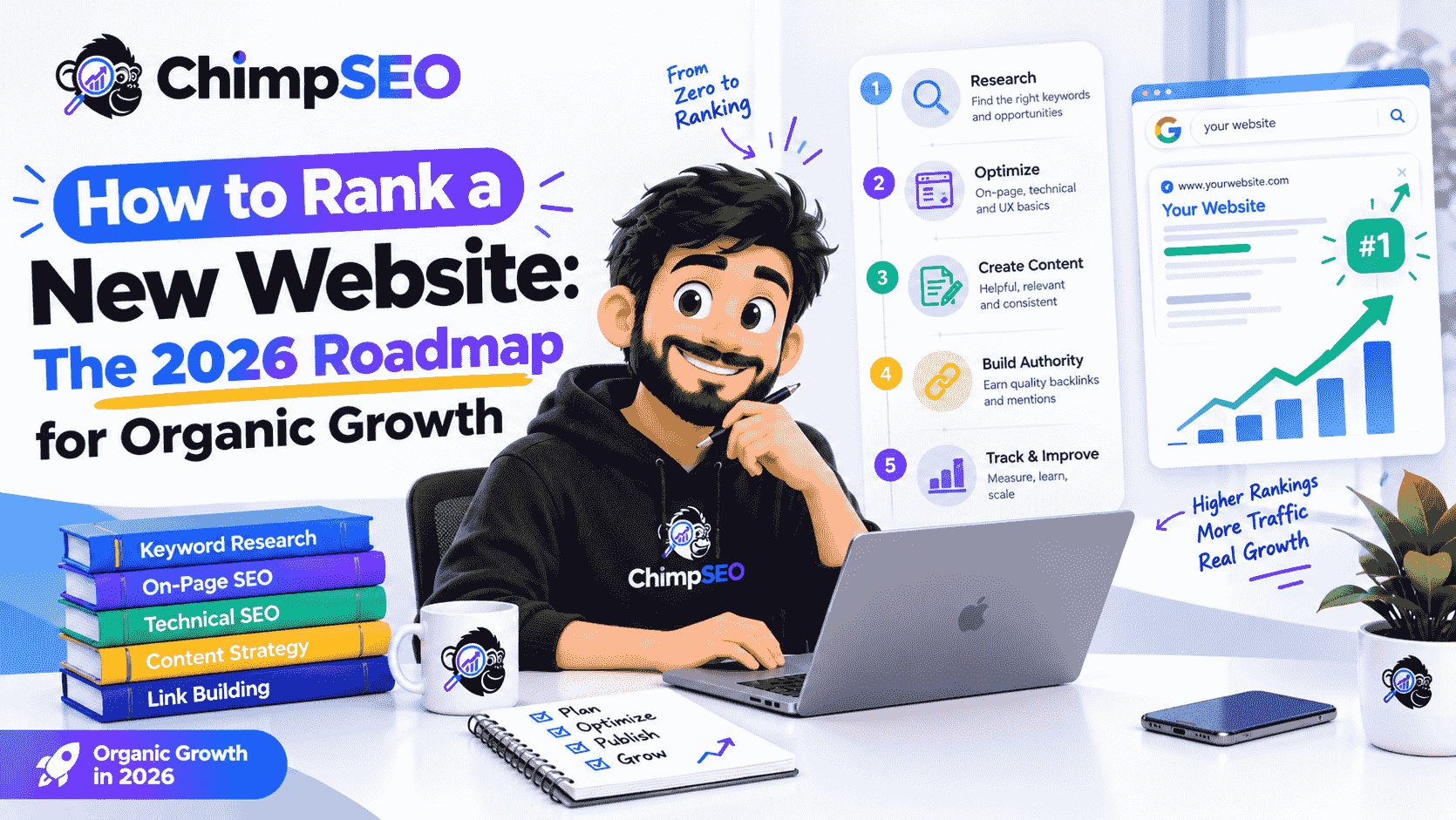
How Google Discovers and Evaluates New Websites
Understanding how search engines function is the first step in learning how to rank a new website. Google uses automated bots, known as crawlers, to discover content across the web. Once discovered, your pages are processed and indexed, making them eligible to appear in search results.
The Fundamentals of Crawling, Indexing, and Serving
Crawling is the process of discovery. Google follows links from known pages to new ones. Indexing is the storage phase, where Google analyzes your content to understand its topic and value. Finally, the serving phase occurs when Google determines your page is the best answer to a user's query. For a new site, this pipeline is often slower as Google builds trust in your domain.
Checking Indexation Status with the 'site:' Operator
To verify if your site is in the index, use the site:yourdomain.com search operator in Google. If your pages appear, they are indexed. If not, you may have technical blocks or your site is simply too new for Google to have prioritized it yet.
Realistic Timelines: How Long Does It Actually Take to Rank?
Ranking a new site is a marathon, not a sprint. In the first 1-3 months, expect minimal traffic as Google performs initial discovery. By months 4-6, you may see traction for long-tail keywords. Competitive terms often require 6-12 months of consistent content and link building to gain meaningful visibility. Utilizing Search Visibility Checkers can help you track these incremental gains.
Phase 1: Setting Up Critical Technical SEO Foundations
Before creating content, you must ensure your site is readable by search engines. Technical SEO is the bedrock of your site's performance.
Configuring Google Search Console and Submitting XML Sitemaps
Google Search Console (GSC) is non-negotiable. It provides direct feedback from Google on crawl errors and performance. Once verified, submit your XML sitemap via the Sitemaps report to help Google find all your pages efficiently. Learn How to Download a Website Sitemap: 7 Expert Methods (2026) to ensure yours is structured correctly.
Creating a Search-Friendly URL Directory Structure
Keep your URL structure simple and logical. Use hyphens to separate words and avoid long, cryptic strings. A clean structure like domain.com/category/topic helps both users and crawlers understand site hierarchy.
Allowing Crawler Access: Managing Robots.txt and Rendering (CSS/JS)
Ensure your robots.txt file does not block critical resources. Modern search engines need to render your JavaScript and CSS to understand the full page experience. Use the URL Inspection Tool in GSC to verify that Google sees your page as a user would.
Mobile Usability and Core Page Experience Requirements
Google uses mobile-first indexing, meaning your site's mobile version is the primary version evaluated. Ensure your design is responsive, loads quickly, and provides a seamless user experience, as these are key components of the Core Web Vitals.
Phase 2: Low-Competition Keyword Strategy for Fresh Domains
Do not attempt to compete for high-volume head terms immediately. You lack the authority to rank for them.
Prioritizing Long-Tail Queries and Specific User Intent
Focus on long-tail keywords—phrases with lower search volume but higher intent. These queries are easier to rank for and often convert better. Use tools like How to Use Semrush to Dominate Search Rankings (2026 Guide) to identify these opportunities.
Structuring Content Around Topic Clusters and Pillar Pages
Organize your content into clusters. A pillar page covers a broad topic, while supporting articles dive into specific sub-topics. This internal linking structure signals topical authority to Google, proving your site is a comprehensive resource on a subject.
Analyzing SERP Competitors to Find Content Gaps
Look at the top-ranking pages for your target keywords. What are they missing? Can you provide more up-to-date information, better examples, or a clearer explanation? Filling these gaps is how you earn your place in the SERPs.
Phase 3: Crafting Authoritative, Rank-Worthy On-Page Content
Content must satisfy the user first. In an era of generative artificial intelligence (AI), unique insights and first-hand experience are your competitive advantages.
Crafting Title Tags, H1s, and Descriptive URLs
Your title tag should be compelling and include your primary keyword. Your H1 should clearly state the page's purpose. Ensure your URLs are descriptive and match the content's intent.
Integrating First-Hand Experience to Stand Out from AI Noise
Google prioritizes E-E-A-T (Experience, Expertise, Authoritativeness, and Trustworthiness). Share original research, personal case studies, or unique perspectives that AI cannot replicate. This is how you build a loyal audience.
Strategic Image Optimization: Descriptive Alt Text and File Naming
Images should be compressed for speed and include descriptive alt text. This improves accessibility and provides additional context for search engines, potentially helping you rank in Google Image Search.
Internal Linking Architecture to Pass Page Authority
Every new post should link to existing, relevant content on your site. This helps crawlers discover new pages and distributes authority throughout your domain. For advanced management, consider using Best Seo Software 2021 methodologies to audit your link health.
Phase 4: Promoting Your Website and Building Initial Backlinks
Backlinks remain a primary ranking factor. Without them, it is difficult to compete for competitive terms.
Earning Natural Links Through High-Value Resources
Create content that people naturally want to link to—data studies, original infographics, or comprehensive guides. High-value resources are the easiest to promote.
Strategic Outreach, PR, and Industry Networking
Don't wait for links to appear. Reach out to bloggers, journalists, and industry peers who might find your content useful. Focus on building relationships rather than just asking for links.
Auditing and Updating Early Content to Maintain Relevancy
SEO is iterative. Regularly audit your content to ensure it remains accurate and relevant. Update outdated stats or expand on sections that users find confusing. Consistent maintenance signals to Google that your site is active and trustworthy.
Common Pitfalls That Prevent New Websites from Ranking
- Targeting Unrealistic Head Keywords: Don't try to rank for "SEO" on day one. Start small.
- Accidental 'noindex' Tags: Always double-check your meta tags during development.
- Duplicate Content: Ensure every page provides unique value.
Key Metrics to Track During Your First 6 Months
Focus on GSC data: impressions, clicks, and the number of indexed pages. While traffic might be low, a steady increase in impressions is a positive sign that Google is beginning to trust your content.
Understanding the 'Google Sandbox' and Maturation Stages
Many SEO practitioners observe a phenomenon often referred to as the 'Google Sandbox,' where new domains struggle to rank for any keywords, regardless of content quality, during their first few months. While Google does not officially confirm a 'sandbox' penalty, search engines do apply a 'trust-building' period. During months 1-3, your focus should be on establishing technical health and indexation. Expect high volatility in rankings during months 4-6 as Google tests your content against different user segments. By months 6-12, the 'maturation phase' begins, where your domain's historical data allows Google to better categorize your site and assign it a baseline topical authority.
Actionable Framework for Building Initial Topical Authority
For a new domain with zero backlink equity, you cannot rely on domain authority to rank. Instead, you must build topical authority. Start by selecting a specific niche—a 'sub-topic' of a larger industry. Create a 'hub' page that acts as the central resource for this niche, then produce 10-15 supporting articles that answer every possible question related to that sub-topic. By internally linking these articles back to your hub page, you signal to Google that your site is a comprehensive, expert source on that narrow subject, making it easier to rank than if you were covering broad, disconnected topics.
Pre-Launch Checklist: Essential Verification and Analytics
Before publishing your first piece of content, you must ensure your data tracking is operational. First, verify your domain in Google Search Console (GSC) using DNS record verification, which covers all subdomains automatically. Second, implement Google Analytics 4 (GA4) via Google Tag Manager to track user behavior beyond just search engine traffic. Finally, create a 'Launch Audit' checklist: confirm your site’s canonical tags point to the correct URL versions, ensure your SSL certificate is active (HTTPS is a ranking signal), and verify that your XML sitemap is dynamically updated to include new posts as they are published.
Strategic Keyword Prioritization for Zero-Authority Domains
Avoid the 'keyword volume trap.' High-volume keywords are usually dominated by sites with years of backlink history. For a new site, use a Keyword Difficulty (KD) vs. Intent matrix. Look for keywords with a KD score of less than 20. These are often long-tail, question-based queries (e.g., 'how to fix X' or 'best Y for Z') that signal high commercial or informational intent. By capturing these specific queries, you generate 'seed traffic' that improves your site's behavioral metrics—like time on page and bounce rate—which are secondary signals that Google uses to determine if your content is worth promoting to more competitive SERPs.
Trade-offs in Content Velocity vs. Quality
A common mistake is believing that more content equals faster rankings. For a new domain, thin or AI-generated content can trigger 'low-quality' signals that haunt your domain for months. The trade-off is clear: prioritize depth over breadth. It is significantly more effective to publish one 2,000-word, highly researched pillar piece per month than ten 500-word generic blog posts. Focus on 'evergreen' content that remains relevant for years, as this provides a stable foundation for your site’s future growth.
Understanding the 'Google Sandbox' and Maturation Stages
Many SEO practitioners observe a phenomenon often referred to as the 'Google Sandbox,' where new domains struggle to rank for any keywords, regardless of content quality, during their first few months. While Google does not officially confirm a 'sandbox' penalty, search engines do apply a 'trust-building' period. During months 1-3, your focus should be on establishing technical health and indexation. Expect high volatility in rankings during months 4-6 as Google tests your content against different user segments. By months 6-12, the 'maturation phase' begins, where your domain's historical data allows Google to better categorize your site and assign it a baseline topical authority.
Actionable Framework for Building Initial Topical Authority
For a new domain with zero backlink equity, you cannot rely on domain authority to rank. Instead, you must build topical authority. Start by selecting a specific niche—a 'sub-topic' of a larger industry. Create a 'hub' page that acts as the central resource for this niche, then produce 10-15 supporting articles that answer every possible question related to that sub-topic. By internally linking these articles back to your hub page, you signal to Google that your site is a comprehensive, expert source on that narrow subject, making it easier to rank than if you were covering broad, disconnected topics.
Pre-Launch Checklist: Essential Verification and Analytics
Before publishing your first piece of content, you must ensure your data tracking is operational. First, verify your domain in Google Search Console (GSC) using DNS record verification, which covers all subdomains automatically. Second, implement Google Analytics 4 (GA4) via Google Tag Manager to track user behavior beyond just search engine traffic. Finally, create a 'Launch Audit' checklist: confirm your site’s canonical tags point to the correct URL versions, ensure your SSL certificate is active (HTTPS is a ranking signal), and verify that your XML sitemap is dynamically updated to include new posts as they are published.
Strategic Keyword Prioritization for Zero-Authority Domains
Avoid the 'keyword volume trap.' High-volume keywords are usually dominated by sites with years of backlink history. For a new site, use a Keyword Difficulty (KD) vs. Intent matrix. Look for keywords with a KD score of less than 20. These are often long-tail, question-based queries (e.g., 'how to fix X' or 'best Y for Z') that signal high commercial or informational intent. By capturing these specific queries, you generate 'seed traffic' that improves your site's behavioral metrics—like time on page and bounce rate—which are secondary signals that Google uses to determine if your content is worth promoting to more competitive SERPs.
Trade-offs in Content Velocity vs. Quality
A common mistake is believing that more content equals faster rankings. For a new domain, thin or AI-generated content can trigger 'low-quality' signals that haunt your domain for months. The trade-off is clear: prioritize depth over breadth. It is significantly more effective to publish one 2,000-word, highly researched pillar piece per month than ten 500-word generic blog posts. Focus on 'evergreen' content that remains relevant for years, as this provides a stable foundation for your site’s future growth.
Frequently Asked Questions
How long does it take for a brand-new website to rank on Google?
Ranking a new site typically takes between 3 to 6 months for low-competition terms, while competitive terms often take 6 to 12 months or longer as Google evaluates site trust, authority, and consistency.
Why is my new website not showing up in Google Search at all?
A site might be missing due to accidental noindex meta tags, robots.txt crawl blocks, an unsubmitted sitemap, or simply because Google's crawlers have not yet discovered and evaluated the new domain.
Can a new website rank without backlinks?
Yes, a new site can rank for ultra-low competition and hyper-specific long-tail keywords based on strong technical SEO and comprehensive content alone, but backlinks are required for broader search visibility.
How often should I publish new content on a new website?
Quality and topical depth matter far more than posting frequency. Publishing 2 to 4 thoroughly researched, well-optimized articles per month is generally better than releasing low-quality posts daily.
Should I target high-volume keywords immediately?
No. New domains lack the authority needed to compete against established sites for high-volume head terms; prioritizing specific, low-competition phrases accelerates early traffic and indexation signals.