✍️ Zeenat Ramzan•📅 September 10, 2026•⏱️ 7 min read
Traditional Search Engine Optimization relies heavily on manual effort: writing individual blog posts, hand-crafting landing page metadata, and building bespoke outreach campaigns. While effective for targeting competitive head keywords, this manual workflow creates an insurmountable bottleneck when attempting to address thousands of granular user search queries.
Programmatic SEO solves this scalability crisis. By replacing manual page assembly with database architecture and dynamic templating, engineering and marketing teams can deploy thousands of contextually rich, search-intent-aligned landing pages simultaneously.
This exhaustive guide breaks down the core taxonomy, technical requirements, dynamic schema integrations, and operational blueprints necessary to build a high-ranking programmatic SEO infrastructure without triggering search engine quality penalties.
Quick Summary: Programmatic SEO is an advanced growth methodology that utilizes structured databases, automated page templates, and dynamic data insertion to automatically generate hundreds or thousands of search-engine-optimized landing pages designed to capture low-competition, high-intent long-tail keyword variations at scale.
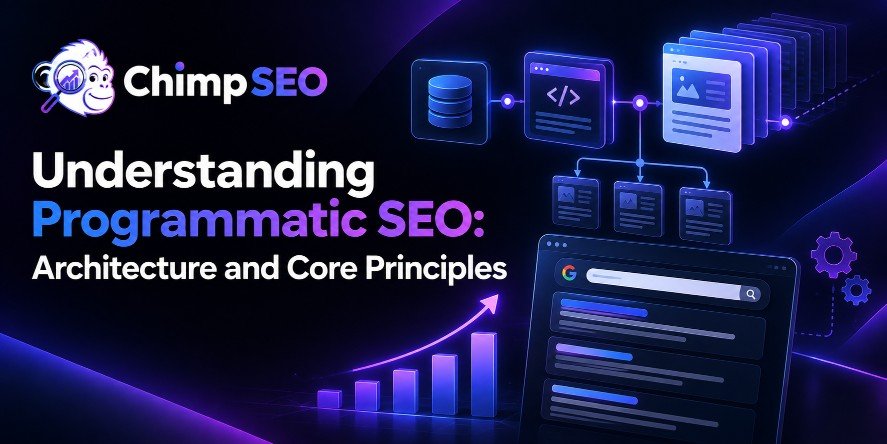
Understanding Programmatic SEO: Architecture and Core Principles
Understanding Programmatic SEO Architecture
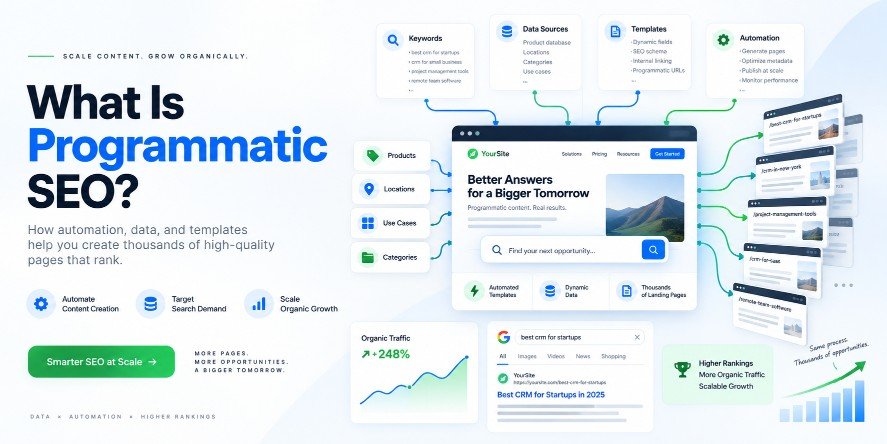
Programmatic SEO operates at the intersection of relational software design, data engineering, and search engine optimization. Rather than drafting static content, developers and SEO strategists create structured databases containing unique data points, attributes, and entities. These inputs populate standardized, highly optimized web page templates.
When executed correctly, programmatic SEO allows brands like Zapier, TripAdvisor, Canva, and Wise to dominate long-tail search results. For example, rather than writing a single article on "How to integrate web apps," Zapier programmatically generated over 50,000 unique landing pages mapping every permutation of Application A and Application B (e.g., "Connect Slack to Google Sheets").
Head Keywords vs. Long-Tail Search Queries
To grasp the economic rationale behind programmatic SEO, you must analyze search demand distribution across search engine results pages (SERPs):
Head Keywords: Search phrases with high individual search volume, extreme keyword difficulty, and broad transactional or informational intent (e.g., "CRM software"). These terms require massive domain authority and long-form editorial content.
Long-Tail Modifiers: Highly specific, multi-word queries with lower individual search volume but exceptionally high conversion rates (e.g., "best real estate CRM for commercial brokers in Austin").
While a head keyword might yield 100,000 monthly searches, the aggregate volume of thousands of long-tail permutations routinely exceeds millions of impressions. Programmatic SEO creates page-level relevance for every single modifier in that search spectrum.
How Programmatic SEO Works: The Database-Driven Workflow
Executing a programmatic SEO campaign requires a multi-stage pipeline where data points flow directly into dynamic visual representations. The process relies on three architectural pillars: Database Structuring, Template Engineering, and Routing Logic.
1. Database Structuring and Variable Mapping
The foundation of any programmatic build is structured, high-grade data. This data can originate from internal product databases, proprietary APIs, publicly available data sets, or programmatic enrichment engines. Each database record acts as a row, while individual variables serve as columns.
For instance, an real estate programmatic directory relies on a structured schema containing records for cities, neighborhoods, median prices, school ratings, and property availability:
{city_name}: Austin
{average_price}: $550,000
{top_school_district}: Eanes ISD
{property_type}: Condos
2. Template Creation & Dynamic Content Insertion
Once data variables are normalized, frontend developers build dynamic landing page layouts utilizing components engineered to hold dynamic strings, condition-based UI blocks, interactive charts, and contextual internal links. Rather than hardcoding text, templates utilize conditional logic markers (such as IF/ELSE statements) to prevent content duplication and ensure structural uniqueness across pages.
💡 Pro Tip: Never rely purely on token substitution (e.g., swapping out city names in identical paragraph blocks). Incorporate conditional rendering rules—such as displaying unique data visualizations or dynamic comparative tables depending on metric availability—to ensure each URL provides unique utility.
Traditional Content Creation vs. Programmatic SEO
Scaling organic footprint manually requires extensive hiring and editorial resources. Programmatic frameworks shift the operational expenditure from human content creation to initial technical architecture and data curation.
Feature / Metric
Traditional Method
ChimpSEO Autonomous AI
Production Rate
2 to 5 articles per week
1,000+ programmatic pages per hour
Target Keyword Focus
Competitive head & middle-tail phrases
Thousands of long-tail intent permutations
Data Architecture
Unstructured text documents
Relational SQL/JSON databases & variable maps
Cost Per Page
$100 – $500 per piece
Fractional cents per generated page
Indexing Management
Manual Google Search Console submissions
Automated dynamic XML sitemaps & API push
Essential Technical Foundations for Programmatic SEO Success
Publishing 10,000 pages overnight presents significant technical challenges. If your site architecture fails to manage crawl budget, dynamic canonicalization, or rendering efficiency, search engine bots may abandon or de-index your site entirely.
1. Managing Crawl Budget & Rendering Speed
Google allocates a finite crawl budget to every domain based on domain authority, server responsiveness, and site speed. When generating huge page matrices, ensure your web server delivers server-side rendered (SSR) or statically generated (SSG) HTML rather than client-side rendered JavaScript.
To verify that your site architecture adheres to web performance criteria, regularly analyze your domain assets with a Technical Site Audit Tool. Resolving slow server response times (TTFB) and broken JavaScript hydrations keeps web crawlers indexing your generated pages efficiently.
2. Strict Indexing Logic and XML Sitemap Division
Do not throw 50,000 new URLs into a single monolithic XML sitemap. Split your sitemaps logically by dynamic category (e.g., sitemap-cities-1.xml, sitemap-cities-2.xml) with maximum allocations of 10,000 URLs per file. This structure makes identifying crawl stalls inside Search Console seamless.
Review technical search indexing standards specified directly within the Google Search Central documentation to ensure your server header responses and indexing directives remain fully compliant.
Implementing Structured Data and Schema at Scale
Programmatic pages provide an ideal foundation for rich search results because data points exist in predictable structural formats. Adding JSON-LD structured data markup allows search crawlers to extract underlying entities immediately.
When building local programmatic pages, e-commerce comparisons, or directory listings, embed standard JSON-LD structures defined by Schema.org standards. Validating these schemas against standard protocols defined by Web Standards bodies ensures high eligibility for rich snippets, FAQ dropdowns, and rating star extensions.
For blog-style automated expansions, combining structured templates with a tailored AI Article Writer helps maintain semantic variation and high-level readability across large publication outputs.
💡 Pro Tip: Automate self-referencing canonical tags on every programmatic page to prevent parameters, sorting queries, or dynamic pagination variants from being flagged as duplicate content.
Step-by-Step Strategy to Launch Your First Programmatic Campaign
Building a successful programmatic system requires methodical execution across data acquisition, template design, and crawling infrastructure.
Step 1: Identify Keyword Modifiers and Search Patterns
Uncover repeatable search patterns within your industry niche. Look for formulas with high modifier variability:
[Product] vs [Product] (e.g., "Ahrefs vs Semrush")
[Service] in [Location] (e.g., "Plumbers in Denver")
[Cost] of [Item] in [Year] (e.g., "Cost of Solar Panels in Ohio 2025")
Step 2: Collect and Sanitize Proprietary Data
Gather data points that directly solve user search intent. Eliminate incomplete records or missing values. If an asset record lacks critical data, apply fallback rules to render customized UI elements rather than leaving empty gaps on the page.
Step 3: Build Pages with an Engine Built for Scale
Leveraging dedicated tools drastically reduces engineering overhead. Using a specialized Programmatic SEO Generator allows you to upload custom CSV datasets, configure variable tags, and auto-generate clean HTML pages optimized for search engines.
Step 4: Establish Internal Linking Networks
Programmatic pages must never exist as isolated link islands. Build dynamic internal linking matrices—such as parent-child directory hierarchies, related location clusters, and breadcrumb structures—to pass PageRank throughout your entire ecosystem.
Avoiding Google Helpful Content Penalties and Programmatic Spam Filters
Search engines continuously refine algorithms to combat doorway pages and low-value content scale. To safeguard your domain against penalties, prioritize user value over pure page volume.
1. Humanizing Data & Adding Proprietary Insights
Avoid releasing pages that contain nothing more than simple text rephrasing of basic search data. Provide real value by featuring interactive calculators, user reviews, filterable datasets, or proprietary custom charts that users cannot find elsewhere.
2. Domain Authority and Off-Page Signals
Launching thousands of pages on a fresh domain with zero backlink authority often leads to indexing issues. To build topical authority, run automated backlink campaigns using a dedicated Backlink Outreach Engine to secure contextual niche placements that drive link equity back to your programmatic category hubs.
3. Continuous Performance Analytics
Track indexed pages, impression growth, and organic conversion paths actively. Utilizing a centralized SEO Growth Dashboard helps you evaluate performance metrics, flag declining traffic nodes, and prune low-performing URLs before they negatively impact domain quality scores.
To explore tiered scaling capabilities and enterprise infrastructure options, review our transparent ChimpSEO Pricing Plans designed to support projects from small local directories to enterprise programmatic deployments.
Frequently Asked Questions
What is the difference between programmatic SEO and traditional SEO?
Traditional SEO focuses on creating individual pieces of content manually, typically targeting one primary head keyword per article. Programmatic SEO utilizes databases, code logic, and automated page templates to publish hundreds or thousands of unique, data-driven landing pages designed to capture low-competition, long-tail keyword variations at scale.
Will Google penalize websites for using programmatic SEO?
No, Google does not penalize programmatic SEO based solely on automated generation. However, Google will penalize domains that deploy thin, repetitive, or non-functional doorway pages that fail to provide unique value to human searchers. Maintaining high data quality, unique structural elements, and high user experience metrics prevents quality penalties.
How many pages do you need for programmatic SEO to be effective?
There is no fixed minimum page count threshold for programmatic SEO. A campaign can be highly effective with 50 hyper-targeted local landing pages or 100,000 product comparison pages. The key metric is whether your target topic contains repeatable modifier formulas with distinct search intent variations.
Do I need to be a programmer to implement programmatic SEO?
While developer skills (such as working with databases, APIs, and web frameworks) were traditionally required, modern platforms and no-code tools make programmatic SEO accessible to marketers. Platforms like ChimpSEO handle variable mapping, template rendering, and XML sitemap distribution automatically without manual code setup.
Supercharge Your SEO with ChimpSEO
Generate rank-ready articles, launch programmatic landing pages, and automate backlink outreach in minutes.