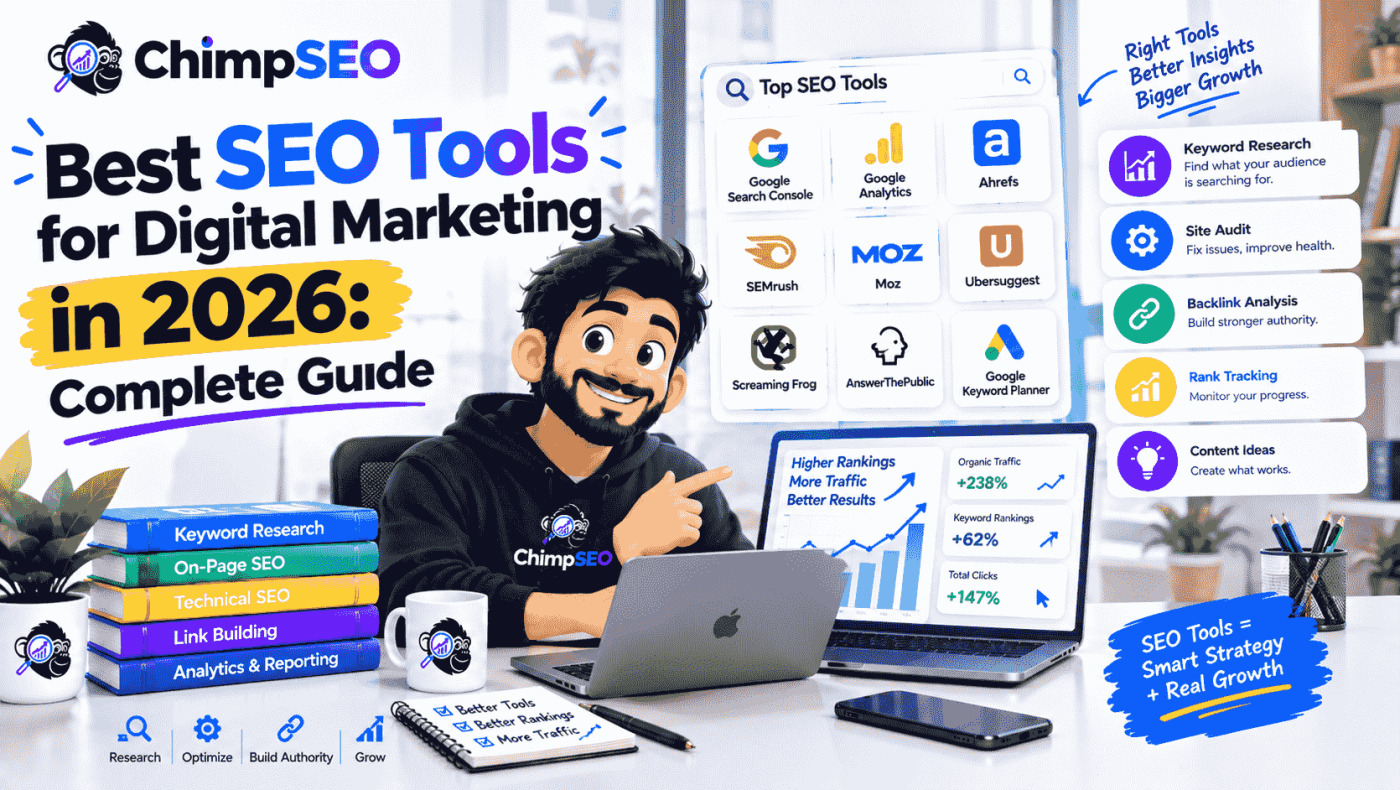
The organic search landscape of 2026 bears little resemblance to the traditional search environment of prior years. With Google AI Overviews, Perplexity, and conversational generative engines managing a substantial portion of search traffic, digital marketers face a fundamental shift. Winning in modern search requires moving beyond manual keyword research and fragmented software subscriptions. Modern growth teams now rely on an integrated stack of enterprise-grade SEO tools for digital marketing to automate technical auditing, semantic content creation, programmatic scaling, and authority building.
Today's search algorithms evaluate websites based on deep topical authority, vector embeddings, structural schema accuracy, and user engagement signals. To maintain a competitive edge, marketing organizations must leverage modern SEO tools for digital marketing that offer real-time NLP analysis, automated crawl efficiency management, and continuous optimization.
1. The Evolution of Search & SEO Tools for Digital Marketing in 2026
Search engines no longer analyze content purely on keyword density or exact-match anchor text. Modern algorithms utilize large language models and neural embedding systems to understand the semantic intent behind search queries. As a result, selecting the right SEO tools for digital marketing requires prioritizing platforms built specifically for entity recognition and Generative Engine Optimization (GEO).
Shift from Keyword Stuffing to Entity-Based Indexing
In the early days of search optimization, digital marketers could secure rankings simply by inserting target terms into titles, meta headers, and body paragraphs. Today, search algorithms build complex knowledge graphs. They connect entities—people, places, concepts, and software platforms—to determine whether a website possesses genuine domain expertise.
Next-generation SEO tools for digital marketing map these entities across competitor ecosystems. By analyzing top-ranking pages through Natural Language Processing (NLP), these platforms identify missing context, required LSI entities, and semantic gaps that must be addressed to achieve topical completeness.
How Search Engines Process Semantic Signals
Search engines process content by creating multi-dimensional vector embeddings. Pages that group related subtopics logically under optimized header structures achieve higher semantic resonance scores. Modern platforms automatically evaluate search intent variations, ensuring that content addresses informational, commercial, and transactional queries simultaneously.
Furthermore, technical infrastructure plays an pivotal role. Search algorithms demand rapid page load times, strict adherence to Google Search Central documentation standards, and clean structured schema markup to index content without wasting crawl budget.
2. Essential Categories of Modern SEO Tools for Digital Marketing
To scale organic acquisition predictably, marketing teams must integrate specific tool categories into their growth stack. Rather than relying on isolated utilities, high-performing organizations use unified automated solutions.
1. Autonomous AI Content & Competitor NLP Tools
Content generation has evolved far beyond basic AI draft generators. Sophisticated SEO tools for digital marketing analyze the top 20 ranking URLs for a target keyword, reverse-engineer the underlying NLP entities, and auto-generate comprehensive, deeply researched articles designed to satisfy both human readers and search crawlers.
These platforms incorporate real-time semantic scoring, ensuring that terms related to topical authority, internal siloing, and indexation are distributed naturally throughout the text without triggering over-optimization penalties.
2. Technical Site Auditing & Crawl Efficiency Platforms
Technical SEO remains the foundation of organic visibility. If search engine bots encounter broken links, redirect loops, or inefficient JavaScript rendering, indexation stalls. Modern technical auditing tools continuously monitor site health, automatically flagging crawl errors, canonical mismatches, and page speed bottlenecks before they impact rankings.
3. Programmatic SEO Engines & Automated Siloing
For enterprise platforms, e-commerce stores, and directory websites, manually building individual landing pages is inefficient. Programmatic SEO tools enable teams to publish thousands of structured, unique, high-intent landing pages targeted at long-tail search queries.
These engines automatically build internal siloing structures, passing PageRank efficiently across parent and child pages while maintaining clean URL architectures.
4. AI-Driven Backlink Outreach & Authority Acquisition
Backlinks remain a primary ranking factor for establishing domain trust. Modern outreach tools streamline link-building by identifying high-authority target sites, discovering verified editor contact details, and personalizing outreach campaigns based on target site content gaps.
3. Comparison: Traditional SEO Workflows vs. Autonomous AI Engines
Transitioning from legacy manual processes to autonomous AI execution drastically reduces production cycles while elevating technical accuracy. Below is a comparative breakdown of traditional methods versus modern autonomous platforms like ChimpSEO.
| Feature / Metric | Manual / Traditional Methods | ChimpSEO Autonomous AI Engine |
|---|---|---|
| Keyword & Content Research | 4 to 8 hours per article using disconnected keyword spreadsheets. | Instant real-time NLP competitor analysis and automated topic extraction. |
| Content Production & Optimization | Manual copywriting requiring multiple editing revisions and external plugins. | End-to-end long-form HTML generation with embedded semantic entities. |
| Technical Auditing & Schema | Periodic manual audits with ad-hoc schema validation. | Continuous real-time site crawling, schema auto-generation, and issue alerts. |
| Programmatic Page Scaling | Custom developer resources required; slow deployment schedules. | Automated programmatic template scaling with integrated dynamic internal links. |
| Link Building & Outreach | Manual email prospecting with low conversion response rates. | AI-personalized pitch outreach matched to contextually relevant publishers. |
4. Step-by-Step Implementation Framework for Organic Growth
Deploying advanced SEO tools for digital marketing effectively requires a structured, repeatable workflow. Following this four-step framework ensures maximum ROI and sustainable ranking growth.
Step 1: Mapping Topical Authority and Search Intent Gaps
Begin by conducting a site-wide content audit to identify missing subtopics within your core vertical. Use competitive gap analysis tools to discover keywords where competitors rank on page one but your domain lacks dedicated coverage. Group these keywords into tight topical clusters centered around primary core pages.
Step 2: Optimizing Crawl Budget and Technical Schema
Before launching new content initiatives, audit your technical foundation. Ensure search engines can access your URLs seamlessly by optimizing your sitemap and resolving canonical issues. Implement JSON-LD structured schema across all core templates—including Article, Product, Organization, and FAQ schema—to provide clear contextual signals to search engines.
Step 3: Generating NLP-Optimized Content at Scale
Utilize modern AI generation platforms to produce comprehensive articles that solve specific user problems. Ensure each piece incorporates target LSI entities naturally across headers, bullet points, and body text. Pay close attention to click-through rate (CTR) drivers like compelling title tags and persuasive meta descriptions.
Step 4: Automating Internal Siloing and Backlink Workflows
Establish strict internal linking rules. Parent guide pages must link down to supporting child topics, while child articles link back up to reinforce authority. Connect automated outreach tools to secure contextual backlinks from authoritative domains within your industry.
💡 Pro Tip: When optimizing for Google AI Overviews and conversational AI engines, place clear 45 to 50-word direct summary definitions immediately beneath your main headings. Generative engines routinely scrape structured answer blocks to populate search answer features.
5. Common Pitfalls When Selecting SEO Tools for Digital Marketing
Even experienced growth leaders can fall into strategic traps when building their technology stack. Avoiding these common mistakes saves budget and prevents long-term technical debt.
Over-Relying on Unverified Third-Party Metrics
Metrics like Proprietary Domain Scores should serve as general guidelines rather than absolute truth. Search algorithms evaluate sites based on real-time relevance, technical health, and user satisfaction rather than arbitrary third-party metrics. Focus on actual indexation rates, organic impressions, and target keyword conversions.
Ignoring AEO and AI Overview Optimization
Focusing exclusively on traditional blue link search results is a mistake in 2026. If your content strategy fails to optimize for AI answer engine summaries, you miss out on high-intent search traffic. Choose SEO tools for digital marketing that monitor citations across conversational platforms alongside standard rank tracking.
Fragmenting Your SEO Tool Stack
Managing six or seven disparate software tools leads to disconnected data, ballooning software costs, and inefficient team execution. Consolidating keyword research, AI content generation, programmatic page creation, and technical auditing into a single autonomous platform streamlines team workflows and accelerates output.
6. Emerging Trends: What to Expect in Late 2026 and Beyond
As artificial intelligence continues to reshape digital marketing, several emerging trends will define the future of search engine optimization.
Generative Engine Optimization (GEO) Convergence
GEO is rapidly integrating with traditional SEO best practices. Platforms that optimize for vector similarity and semantic consistency will dominate both traditional search engine result pages (SERPs) and conversational AI responses. Content structures must prioritize clear logical formatting, structured tables, and verifiable facts.
Real-Time Algorithmic Adaptation
Future SEO tools for digital marketing will not just report ranking changes; they will dynamically adapt page elements in real time. Autonomous platforms will continuously adjust internal links, refresh outdated content blocks, and auto-update structured schema based on live search performance data.
7. Frequently Asked Questions
What are the most important SEO tools for digital marketing in 2026?
The most important tools are those that combine autonomous AI content creation, real-time competitor NLP analysis, programmatic page generation, and technical site auditing. All-in-one platforms like ChimpSEO eliminate the need for fragmented software stacks by automating these functions end-to-end.
How does AI change the choice of SEO tools for digital marketing?
AI transforms tools from passive analytics platforms into active execution engines. Rather than merely highlighting issues or keyword lists, modern AI tools automatically generate optimized content, format structured schema, build internal links, and streamline backlink outreach.
Is programmatic SEO still effective for scaling web traffic?
Yes, programmatic SEO remains one of the most effective ways to capture long-tail search intent. However, success in 2026 requires generating unique, high-value content for every programmatic page, avoiding thin dynamic templates, and maintaining clean internal siloing structures.
How do modern SEO tools help with Google AI Overviews and Perplexity?
Modern platforms analyze how generative engines summarize search topics. They identify missing entities, recommend direct-answer formatting structures, and verify schema implementation to increase the likelihood of your content being cited inside AI summary boxes.
8. Final Thoughts: Building a Scalable SEO Stack
Achieving organic dominance in 2026 demands a shift from manual execution to automated intelligence. Equipping your marketing team with advanced SEO tools for digital marketing ensures that your platform builds lasting topical authority, maintains flawless technical site health, and scales content seamlessly.
By leveraging an all-in-one autonomous platform, digital growth leaders convert search engine updates into distinct competitive advantages, driving qualified traffic and sustained revenue growth.
Automate Your Entire SEO Workflow with ChimpSEO
Build topical authority, uncover high-ROI keyword gaps, scale programmatic landing pages, and generate competitor-crushing semantic content on autopilot.
Start Ranking with ChimpSEO Free →